
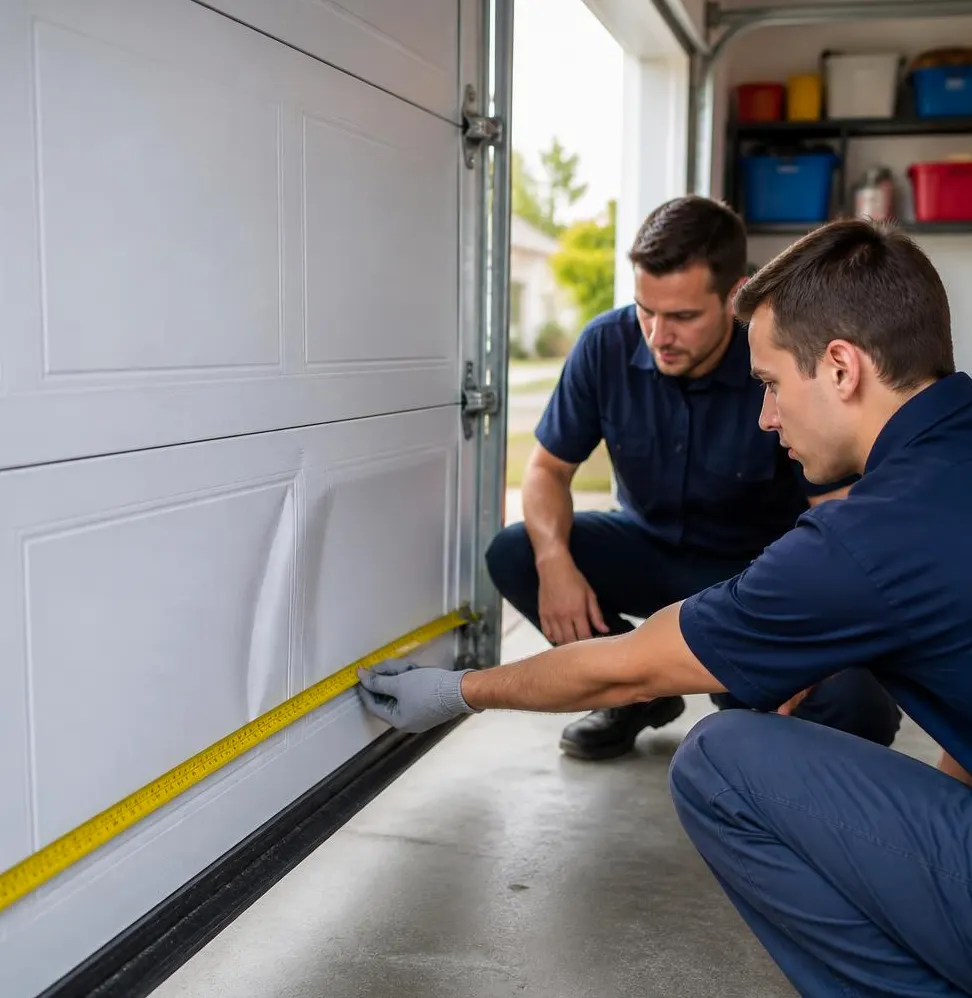
The Fix Everyone Tries First
When a garage door starts rubbing, grinding, or jumping at one spot, most homeowners do the same thing: they grab a rubber mallet, a pry bar, or just their hands and try to bend the track back into place. It's an understandable impulse. The track is right there, the bend is visible, and it looks like a simple mechanical problem with a simple mechanical fix. Unlike a broken spring or a dead opener, nothing seems electrical or dangerous about it.
The problem is that garage door track is galvanized steel formed to a precise shape, and it's holding a door that weighs well over a hundred pounds under spring tension. Hand-bending it rarely restores the original geometry. More often it work-hardens the metal at the bend point, making it weaker and more likely to crack or kink again under load. It can also push the track out of parallel with its partner on the other side, which throws off roller travel on both sides of the door, not just one.
Symptoms That Point to a Track Problem
- Binding or jerking at the same spot every time the door opens or closes, rather than smooth travel top to bottom.
- Grinding or scraping noise localized to one section of track instead of general squeaking.
- A visible gap between a roller and the track wall, or a roller that looks like it's riding on the edge instead of inside the channel.
- The door reversing unexpectedly partway through a cycle, which often means the opener's force sensor is detecting resistance from a binding track.
- Uneven sealing at the bottom of the door, with daylight or a draft on one side but not the other.
- A door that's come off the track entirely and won't move at all, usually accompanied by a loud bang when it happened.
Any of these is worth addressing quickly. A door that's straining against a bent track is also straining the opener motor, the cables, and eventually the springs, turning a track problem into a multi-part repair.
Causes, in the Order a Technician Checks Them
1. Loose or Shifted Mounting Brackets
This is the first thing checked because it's the most common and the cheapest to fix. Tracks are bolted to the wall studs and the door jamb through brackets, and those fasteners back out over time from vibration every time the door cycles. Austin's long hot summers followed by cooler stretches also mean repeated expansion and contraction of the framing and hardware, which gradually loosens bolts that were snug when installed. The fix is straightforward: re-tighten or reposition the brackets, check that both tracks are plumb and parallel, and confirm the door moves freely through a full cycle.
2. Direct Impact
Next, a technician looks for an obvious hit: a car bumper, a bike, a ladder, or storm debris. Austin's sudden severe storms can throw branches and wind-blown debris hard enough to dent a track or panel. A sharp, localized bend from impact usually can't be safely hammered flat; the section is cut out and replaced with matching gauge track, then re-leveled against the undamaged sections.
3. Worn or Broken Rollers
Rollers that have gone flat-sided, cracked, or seized in their bearings pull the door at a slight angle every time it travels, and over months that steadily walks the track out of alignment even without any single impact. Replacement rollers, typically nylon for quieter and smoother operation, are swapped in and the door balance is rechecked.
4. Door Panel Damage
Sometimes the track isn't the root problem at all; a warped or hail-dented panel is pulling the track with it as the door moves. This shows up as a bend that reappears right after a straightening attempt. The technician checks panel flatness before touching the track again, since fixing the track without addressing a bowed panel just means doing the work twice.
5. Foundation or Jamb Movement
Central Texas's clay-heavy soil expands and contracts with moisture swings, and that movement can shift a garage door jamb out of square over months or years, even in a well-built home. This shows up as a track that's technically undamaged but no longer plumb relative to the opening. The fix involves re-shimming and re-anchoring the brackets to bring the track back into proper alignment with the current frame, not the original one.
6. Wind Load and Racking
During high-wind events, a door without adequate bracing can rack, flexing side to side and stressing the tracks at the top rollers. This is checked last because it's less common but worth ruling out after a known storm, especially on older doors without reinforcement struts.
When to Call Austin Garage Door Pro
If your door has come off the track, is grinding at one spot, or reverses on its own, stop running the opener and call rather than attempting to force it back into place. Austin Garage Door Pro's garage door repair service includes full track inspection, bracket re-anchoring, and roller replacement, and when a section is bent beyond safe repair, straightforward track replacement matched to your existing door. If the misalignment has already stressed the cables or springs, that gets addressed at the same visit rather than as a surprise second trip. For a door that's completely stuck off its track, our emergency garage door service covers same-situation calls across Austin, Cedar Park, Round Rock, Pflugerville, Leander, Lakeway, Bee Cave, and Georgetown.
If your garage door is sticking, scraping, or off its track, call Austin Garage Door Pro today and get it running straight and quiet again.